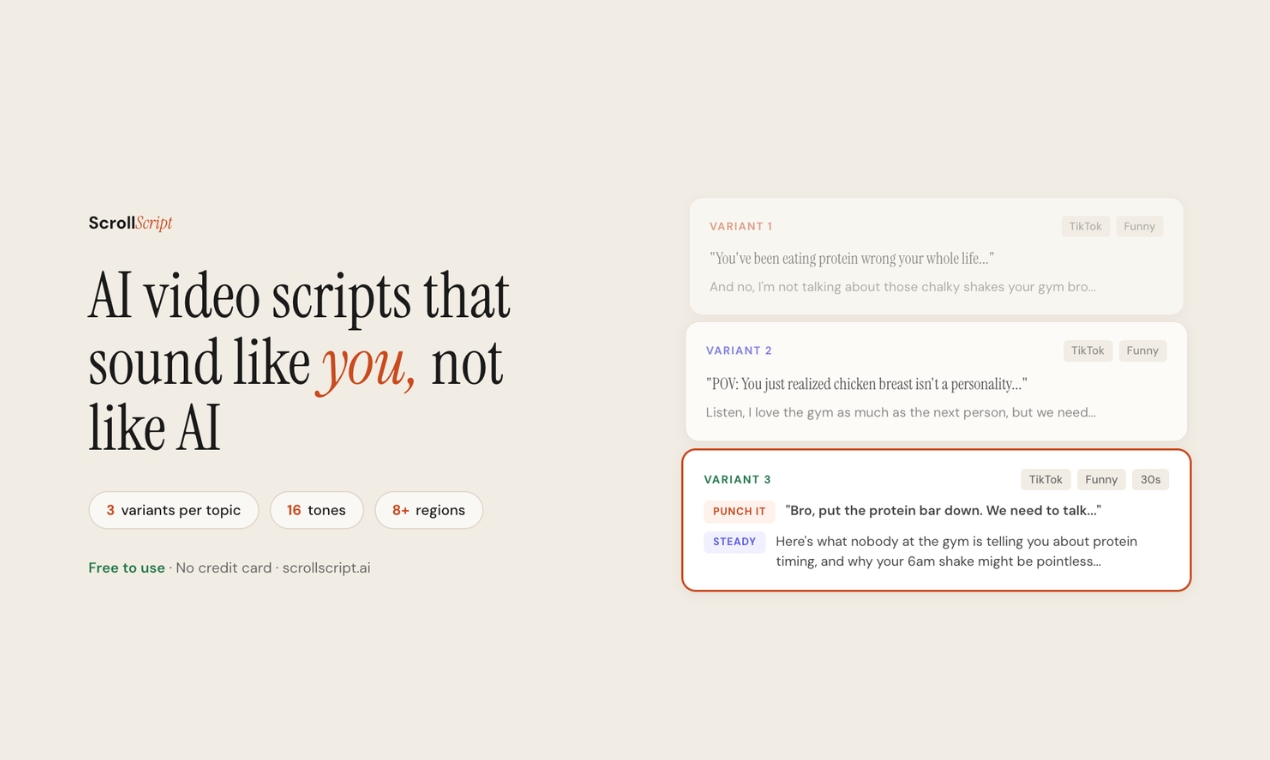
Since ScrollScript launched, creators have generated 1,318 scripts across 427 topics. We've watched the patterns, and some of what the data shows is genuinely surprising.
This is not a post about what should work based on best practices. It's about what creators are actually choosing when they have complete freedom to pick any platform, tone, duration, and topic they want.
Platform split: TikTok leads but Reels is closing fast
Of the 427 topics generated:
- TikTok: 49% (207 topics)
- Instagram Reels: 41% (175 topics)
- YouTube Shorts: 11% (45 topics)
TikTok's lead is narrower than most people expect. Reels is not a secondary platform for these creators — it's nearly equal. YouTube Shorts, despite being the most algorithmically rewarding for subscriber growth, gets a fraction of the attention.
The likely reason: creators who come to a script tool are already active on TikTok and Reels. YouTube Shorts creators tend to repurpose from long-form content and script less deliberately.
Duration: almost nobody scripts 15-second videos
The duration breakdown tells a clear story about how creators think about scripted content:
- 30 seconds: 56% (241 topics) — by far the most common
- 60 seconds: 21% (90 topics)
- 90 seconds: 11% (45 topics)
- 15 seconds: 10% (41 topics)
- 3 minutes: 2% (10 topics)
30 seconds dominates because it's long enough to deliver value but short enough to maintain watch time. 15-second scripts are surprisingly rare — at that length, most creators feel the hook is the script, so writing it out in advance feels unnecessary.
The 3-minute scripts are almost exclusively educational content creators who are using ScrollScript to outline long-form ideas before recording.
Tone: Educational wins by a massive margin
This is the most striking finding. When creators pick a tone with no constraints, 35% choose Educational as their primary tone. Nothing else is close.
The top 5:
- Educational: 35%
- Educational + Storytelling: 4%
- Educational + Motivational + Storytelling: 3%
- Rant: 3%
- Storytelling: 3%
The dominance of Educational makes sense when you think about what scripts are for. If you already know what you want to say emotionally or entertainingly, you don't need a script — you just talk. Scripts are most valuable when you need to organise information and deliver it clearly. That's an educational problem.
Rant and Storytelling both showing up at 3% suggests a meaningful segment of creators who are using scripts not to organise information but to sharpen emotional delivery — making sure the anger lands right or the story arc holds.
What topics are creators actually scripting?
Analysing the 427 topics, a few patterns stand out.
Finance and money content is the single biggest category. Topics like "One Money Habit That Transformed Me," "Affordable Cars for Young Pros," and similar finance-adjacent scripts appear consistently. Finance creators are heavy users of scripting tools because the content involves specific numbers and claims that need to be accurate and clearly sequenced.
Fitness and health is second. "Protein Picks for Gym Newbies," "Growth Through Fitness on the Field" — workout, nutrition, and body-related content. These creators need scripts because they're often filming while distracted and need the words pre-loaded.
Creator education and growth advice is third. Content about building audiences, monetisation, and the craft of content creation. Meta-content about creating content. This makes sense — people who think carefully enough about their craft to script it are also interested in the craft itself.
Geography is more diverse than expected. Topics were generated in English, French, Arabic, Spanish, and Portuguese. We saw references to Al Khobar, Lagos, and Mumbai alongside US and UK references. The audience for short-form video scripting is genuinely global.
What this means for your scripts
A few practical takeaways from the data.
If you're not scripting 30-second content, you're in the minority. Most creators who script are working in that 30-second window. It's not because 30 seconds is always optimal — it's because that's where scripting adds the most value relative to effort.
The hook is not enough on its own. The data shows creators want full scripts with timestamps and visual directions, not just hook suggestions. The 30-second format demands that every line earns its place, and the delivery structure matters as much as the words.
Educational content scales. If you're choosing between a funny video and an educational one, the data suggests the educational angle has more consistent demand. Funny content depends heavily on execution — a great script can't save poor delivery. Educational content can still land even when the delivery is imperfect.
Want to see what your scripts look like? ScrollScript generates 3 ready-to-film variants for any topic — with timestamps, visual directions, and a delivery guide. [Try it free →]